01 The trade that stopped
For most of the colonial period New Mexico was the far end of a very long supply line. The nearest workshops capable of producing altar paintings and carved saints were in Mexico City, some 1,500 miles south down the Camino Real, and a shipment took months and arrived rarely. Village churches still needed images. Households still kept altars. So New Mexicans made their own.
What grew out of that shortage is the santero trade: men, and later women, who painted saints on hand-adzed pine boards and carved them in the round from dry cottonwood root, sizing the wood with gesso made from local gypsum and colouring it with pigments ground from earth, minerals and boiled plants. It was not folk art in the sentimental sense. It was church supply, made under constraint by people who knew exactly what a retablo was for.
The best of it was made roughly between 1780 and 1860, and enough survives that individual hands can be told apart even when no name attaches to them: Pedro Antonio Fresquís, working around Truchas; the anonymous painter known as the Laguna Santero; Molleno; José Rafael Aragón, whose work is in churches all over the north; and late in the century the carver José Benito Ortega, who worked the villages of the northeast.
The trade ended quickly and for an ordinary reason. The railroad reached New Mexico in 1880 and began delivering mass-produced plaster statuary and colour lithographs by the crate, cheaper than a carver could work and shinier than anything he could make. Within a generation the village santero was no longer a paying trade. The skills survived in a few families as private habit. The market for them did not.
02 1925, 1926 and two outsiders
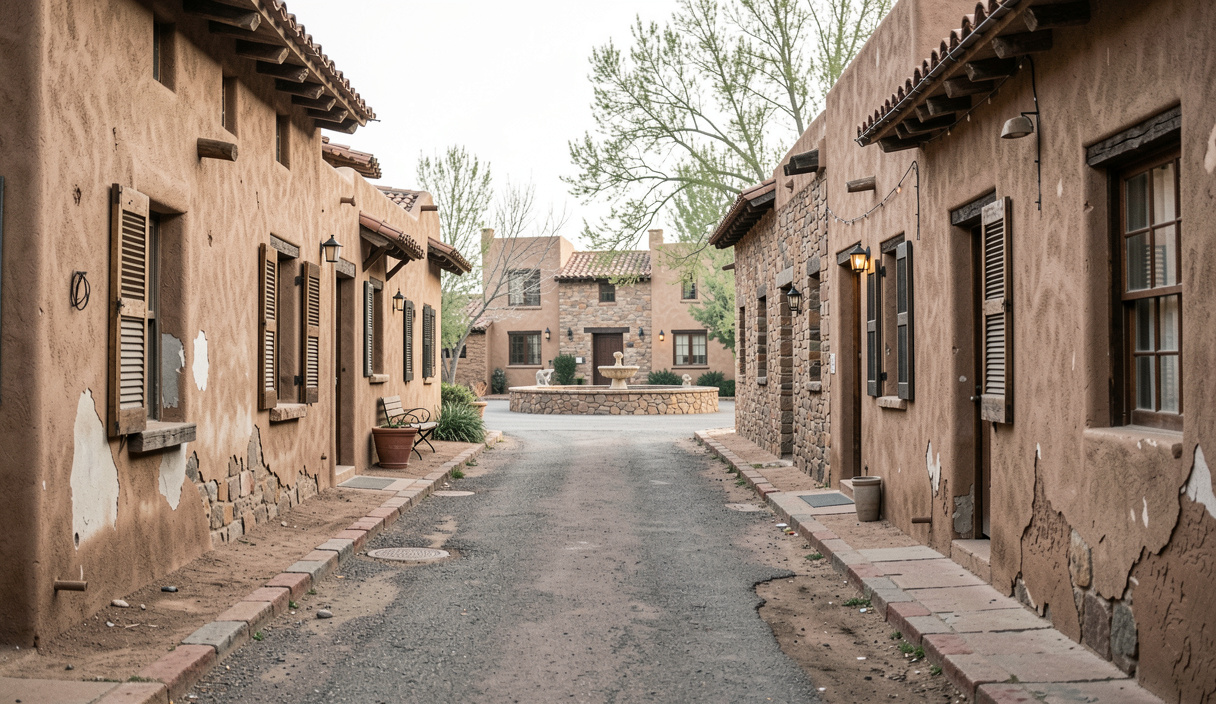
The revival was started by two people who were not from New Mexico. Mary Austin, the writer best known for The Land of Little Rain, had settled in Santa Fe in 1924. Frank Applegate was a painter and collector who had been buying old santos out of village churches and houses and had noticed what the prices told him: the objects were being treated as junk by the people who owned them and as curiosities by the people who bought them.
In 1925 the two founded the Spanish Colonial Arts Society. Their argument was commercial rather than curatorial, and it is still the argument the market rests on: a craft is not saved by putting it in a museum case, it is saved by giving it a paying market and a standard to meet. The first Spanish Market followed in 1926, on the Plaza.
| Year | What happened | Why it still matters |
|---|---|---|
| 1925 | The Spanish Colonial Arts Society is founded by Mary Austin and Frank Applegate | The Society, not the city, sets and polices the standards to this day. |
| 1926 | The first Spanish Market is held on the Plaza | The location has barely moved in a century. |
| 1965 | The market is revived after a long lapse | Everything you see on the Plaza today descends from that restart. |
| 2002 | The Museum of Spanish Colonial Art opens on Museum Hill | The Society's collection is finally on permanent public display, two miles from the market. |
Austin and Applegate did not live to see it work. Applegate died in 1931, Austin in 1934, and the market they founded went into the Depression without them.
03 The long gap and the 1965 revival
The market faltered through the 1930s and stopped through the war years. The tradition itself did not, and the reason is worth knowing because it explains why there was anything left to revive.
Through the Depression the federal art projects put New Mexican carvers and weavers on payroll to furnish public buildings, which kept hands working when nobody was buying. Patrocinio Barela of Taos came out of that programme and had his carvings shown at the Museum of Modern Art in New York in a 1936 survey of federal art project work. In Córdova, on the High Road, the López family turned unpainted carving into a village style distinctive enough to become the thing collectors asked for by name; George López was recognised with a National Heritage Fellowship in 1982.
In 1965 the Society restarted the market on the Plaza. It has been held every year since, apart from a virtual edition in 2020, and it settled into its present shape: the last full weekend of July, around two hundred juried artists, and a set of categories defined by what New Mexican tradition actually contains rather than by what sells.
04 What the jury allows
This is the part that surprises first-time visitors. At Spanish Market an artist does not choose a medium and enter it: they enter a named traditional category, and both the form and the materials are assessed against what that category historically was. The rules are why some remarkable Hispano artists show a hundred yards away at the Contemporary Hispanic Market instead.
| Category | What it is | What tradition constrains |
|---|---|---|
| Retablo | A saint painted on a flat panel | Hand-worked pine, a gesso ground, and pigments in the historic range rather than commercial paint. |
| Bulto | A saint carved in the round | Cottonwood root or pine, gessoed and painted; the posture and attributes follow the saint's iconography. |
| Reredos | A full altar screen, sometimes taller than the artist | Church models: scale, panel divisions and joinery. |
| Straw appliqué | Designs built from split, flattened straw on a dark ground | Real straw, cut and laid by hand, so that it reads as gold without any gilding. |
| Tinwork | Frames, sconces and nichos in worked tin, often set with glass | Hand-cut and hand-stamped sheet, in the vocabulary of nineteenth-century New Mexican shops. |
| Colcha embroidery | Wool embroidery worked on a woven wool ground | Handspun yarn, traditional dyes, and the long colcha stitch itself. |
| Rio Grande weaving | Blankets and rugs from the treadle loom | Handspun wool and the banded designs that came up the Camino Real and stayed. |
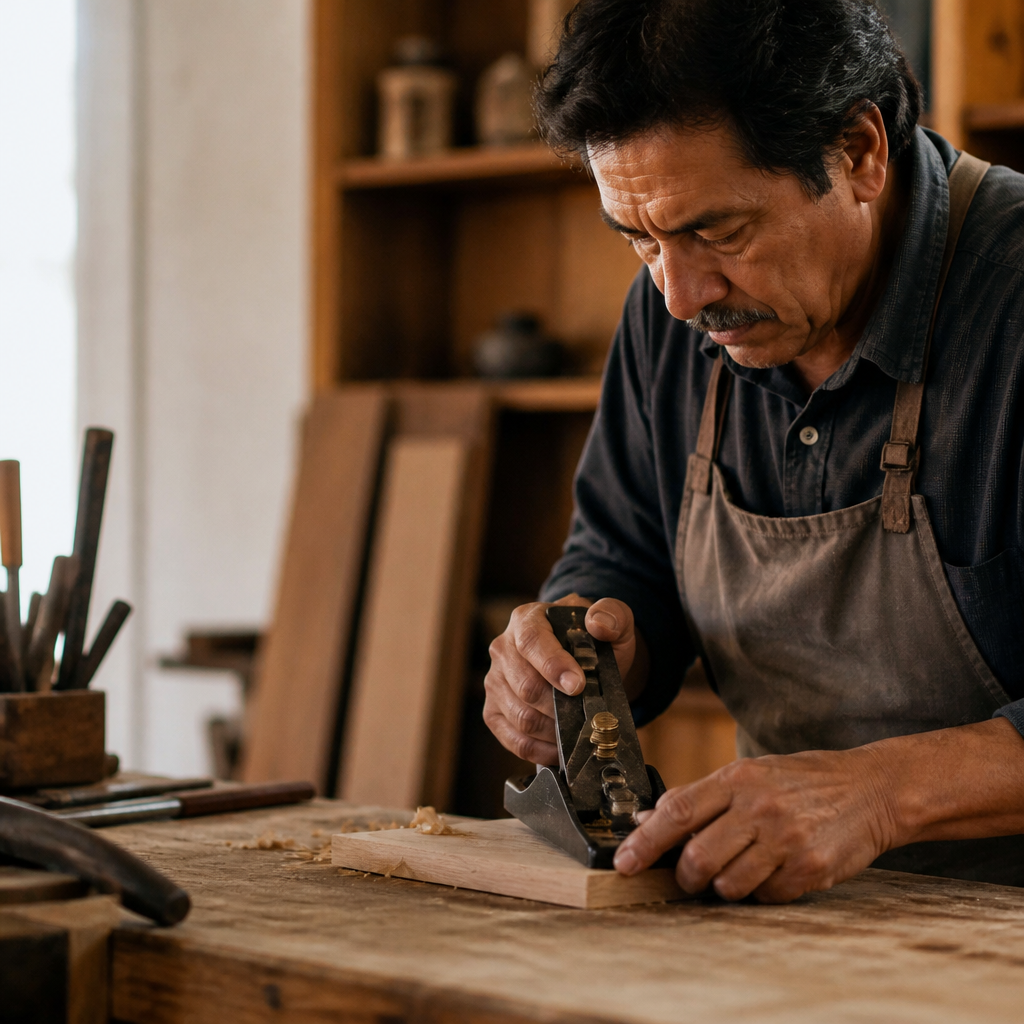
| Furniture | Chests, benches and trasteros | Hand tools and traditional joinery rather than modern fastening. |
| Ironwork | Crosses, hardware, candle stands | Forged at the anvil, not cast. |
| Precious metals | Filigree, crosses, reliquaries | Drawn wire and solder, in the filigree vocabulary of the region. |
| Hide painting | Images painted on tanned hide | A form older than the panel retablo, revived from surviving examples. |
| Ramilletes | Paper flowers made for the altar | Cut and folded by hand, in the colours and forms churches actually used. |
Work is judged before the doors open, exactly as at Indian Market, so ribbons are already on the booths when the public arrives on Saturday morning. If you want to understand what the ribbons mean, walk the whole Plaza once and look only at the awarded pieces: an hour of that teaches more about the standard than any label does.
05 The other markets that weekend
Three separate things happen on and around the Plaza on the same July weekend, and visitors routinely conflate them.
- Traditional Spanish Market, on the Plaza, run by the Spanish Colonial Arts Society, inside the categories above.
- Contemporary Hispanic Market, along Lincoln Avenue, run by a separate organisation, showing Hispano artists working outside those categories: painting, photography, contemporary sculpture, jewellery. It exists precisely because the traditional rules are strict, and it is worth an hour on its own terms.
- The youth market, where young artists show beside the adults. This is the part of the weekend to watch if you want to know whether a trade is actually being passed on rather than merely preserved. Several of the strongest names on the Plaza started there.
There is also a smaller Winter Spanish Market in early December, held indoors. It is a quarter of the size, a tenth of the crowd, and by some distance the easier place to talk to an artist at length.
If the July weekend is already full
The Plaza is at capacity that weekend and rooms go months ahead. The lead-time table sets out how far in advance each Santa Fe weekend fills, and the neighborhoods chapter explains what you give up by staying further out. The December market asks none of that of you.
06 Seeing the tradition off the Plaza
The market is two days. The tradition is on public view all year, within an hour's drive, and an afternoon spent on it beforehand changes what you notice in the booths.
- The Museum of Spanish Colonial Art, on Museum Hill, holds the Society's collection: the historic retablos and bultos against which the jury's standard is set. It is the single best hour of preparation. See the Museum Hill section.
- El Rancho de las Golondrinas, south of the city on an old stopping place of the Camino Real, is a living history site where the trades are demonstrated in the buildings they belong to.
- El Santuario de Chimayó, built between 1813 and 1816 on the High Road, is the reason a great deal of this work exists at all, and the destination of the Holy Week walk described in the events chapter.
- Córdova and Truchas, further up the same road, still have working carvers and small studios. The High Road is the drive.
07 The words on the label
Booth labels at Spanish Market are written in the trade's own vocabulary and almost never translated.
- Santero, santera
- The maker of saints. Historically a village trade, frequently hereditary, and still often learned inside a family rather than a school.
- Retablo
- A holy image painted on a flat panel, traditionally pine sized with gesso. The most common category at the market.
- Bulto
- A saint carved in the round, usually from dry cottonwood root, then gessoed and painted.
- Reredos
- An altar screen: several painted panels assembled into a single architectural piece behind an altar.
- Gesso
- The white ground laid over wood before painting, traditionally made here from local gypsum and animal glue.
- Colcha
- A long New Mexican embroidery stitch, and by extension the wool-on-wool textiles worked with it.
- Hojalatería
- Tinwork. Frames, nichos, sconces and crosses cut and stamped from sheet tin, often combined with glass and wallpaper.
- Ramillete
- A made flower, cut and folded from paper, for a church or home altar.
- Trastero
- A tall standing cupboard, the characteristic piece of New Mexican case furniture.
- Juried
- Admitted by a panel that measures the work against published standards. It is the whole difference between this market and a craft fair.