01 Before 1610: Oga Po'ogeh
The Santa Fe valley was Tewa country long before it was Spanish. Tewa-speaking Pueblo people farmed the drainage of the Santa Fe River, and the area carries the Tewa name Oga Po'ogeh, usually translated as "white shell water place". Ancestral villages stood in and near the present city before the Spanish arrived, and their descendants live today in the pueblos strung along the Rio Grande and its tributaries north of town.
This matters for more than politeness. New Mexico has twenty-three federally recognized tribes and nations: nineteen Pueblos, three Apache tribes and the Navajo Nation. Eight Pueblos sit within an hour of the Plaza, and several of the things a visitor most wants to see (the portal program on the Plaza, feast day dances, the pottery of San Ildefonso and Santa Clara) are Pueblo institutions operating on their own terms, not attractions the city runs.
02 The villa and the Plaza
Spanish colonists founded the villa of Santa Fe around 1610 under governor Pedro de Peralta, giving it the full name La Villa Real de la Santa Fe de San Francisco de Asís. It became the capital of the province of Nuevo México and has been a seat of government ever since, which is the basis for the standard claim that it is the oldest capital city in the United States.
The Plaza was laid out the way Spanish colonial towns were supposed to be laid out, following the Laws of the Indies: a rectangular open space with the government building on one side and the church nearby. The Palace of the Governors on the north side dates to that first decade and is routinely described as the oldest continuously occupied public building in the country. It is now part of the New Mexico History Museum.
The Plaza you walk today is smaller than the original. The colonial plaza extended considerably further east, roughly to where the cathedral now stands, and was eaten into by buildings over the following centuries. That is why the east side feels compressed and the streets around it run at angles that make no sense on a grid.
03 1680: the Pueblo Revolt
In August 1680 the Pueblo nations, coordinated across dozens of villages and several languages under the leadership of Po'pay of Ohkay Owingeh, rose against Spanish rule. Santa Fe was besieged, the colonists were driven out, and the survivors retreated some 300 miles south to El Paso del Norte. Pueblo people held the region for twelve years. It remains the only sustained expulsion of a European colonial power from territory in what is now the United States.
Diego de Vargas returned in 1692 and the Spanish reoccupied Santa Fe over the following year, by a combination of negotiation and force depending on which account you read. That reoccupation is what the annual Fiesta de Santa Fe commemorates, and the argument about how it should be commemorated is one of the live civic debates of the last decade. The chapter on the signature events sets out what changed and when.
A visitor standing on the Plaza is therefore standing on the site of a siege, a reconquest and an unfinished argument. Nothing on the ground says so. That is worth knowing before forming an opinion about the empty pedestal in the middle.
04 1821: the trail arrives
Under Spanish rule, trade with the United States was forbidden. Mexican independence in 1821 changed that overnight, and William Becknell took the first wagons east to west along what became the Santa Fe Trail. For roughly sixty years the trail ran from Missouri to the southeast corner of the Plaza, where a stone still marks the end of it.
The trail met an older road at the same point. El Camino Real de Tierra Adentro ran north from Mexico City for some 1,600 miles, and Santa Fe sat near its northern end. Both are now National Historic Trails. If you want a single image for what the Plaza was, it is this: the place where a road from Mexico City met a road from Missouri, in a town of a few thousand people.
Local note
The railroad, when it finally came in 1880, missed Santa Fe. The main line went through Lamy, eighteen miles southeast, and the city got a branch. That accident of engineering kept Santa Fe small and poor for a generation, which is precisely why so much of the old fabric survived to be rediscovered and marketed after 1912. Lamy is still the nearest Amtrak stop.
05 1846 to 1912: territory and state
Stephen Watts Kearny took Santa Fe without a battle in August 1846 during the war between the United States and Mexico, and the Treaty of Guadalupe Hidalgo transferred the territory in 1848. New Mexico then waited an unusually long time for statehood: sixty-four years, ending on 6 January 1912. The delay had a great deal to do with how a Spanish-speaking, largely Catholic, largely Hispano and Native population was viewed in Washington.
Statehood coincided with a decision that shaped everything a visitor now sees. In 1912 a city planning board, with archaeologists and artists prominent among its members, proposed that Santa Fe should deliberately build in an idealized version of its own older styles. The city was poor, the railroad had passed it by, and its distinctiveness was the only asset it had. The plan worked so well that most people cannot tell 1610 from 1930 on the Plaza, which was the point.
06 Why everything is brown
The short answer is that it is the law. Santa Fe adopted a historic styles ordinance in 1957 that governs building in the historic districts: massing, wall finish, window proportion, parapet line, and above all color. Two approved vocabularies dominate, and telling them apart is the single most useful piece of architectural literacy a visitor can acquire.
| Feature | Spanish-Pueblo Revival | Territorial Revival |
|---|---|---|
| Wall finish | Rounded, soft-edged stucco imitating mud plaster | Flatter stucco, crisper corners |
| Roof line | Irregular stepped parapets, no trim | Straight parapet capped with a course of brick |
| Windows and doors | Deep-set, small, few and irregular | Regular, larger, with painted wood trim |
| Timber | Round vigas projecting through the wall | Squared posts, often with simple capitals |
| Period imitated | Pre-1846 mission and pueblo building | 1846 to 1880, after Anglo-American carpentry arrived |
Once you can see the brick coping on a Territorial parapet you will see it everywhere, and the city stops being uniformly brown and starts being two clearly different arguments about what Santa Fe should look like. Neither of them, it is worth saying, is simply "old": both are twentieth century revivals, applied to concrete block as readily as to adobe.
07 The Plaza today
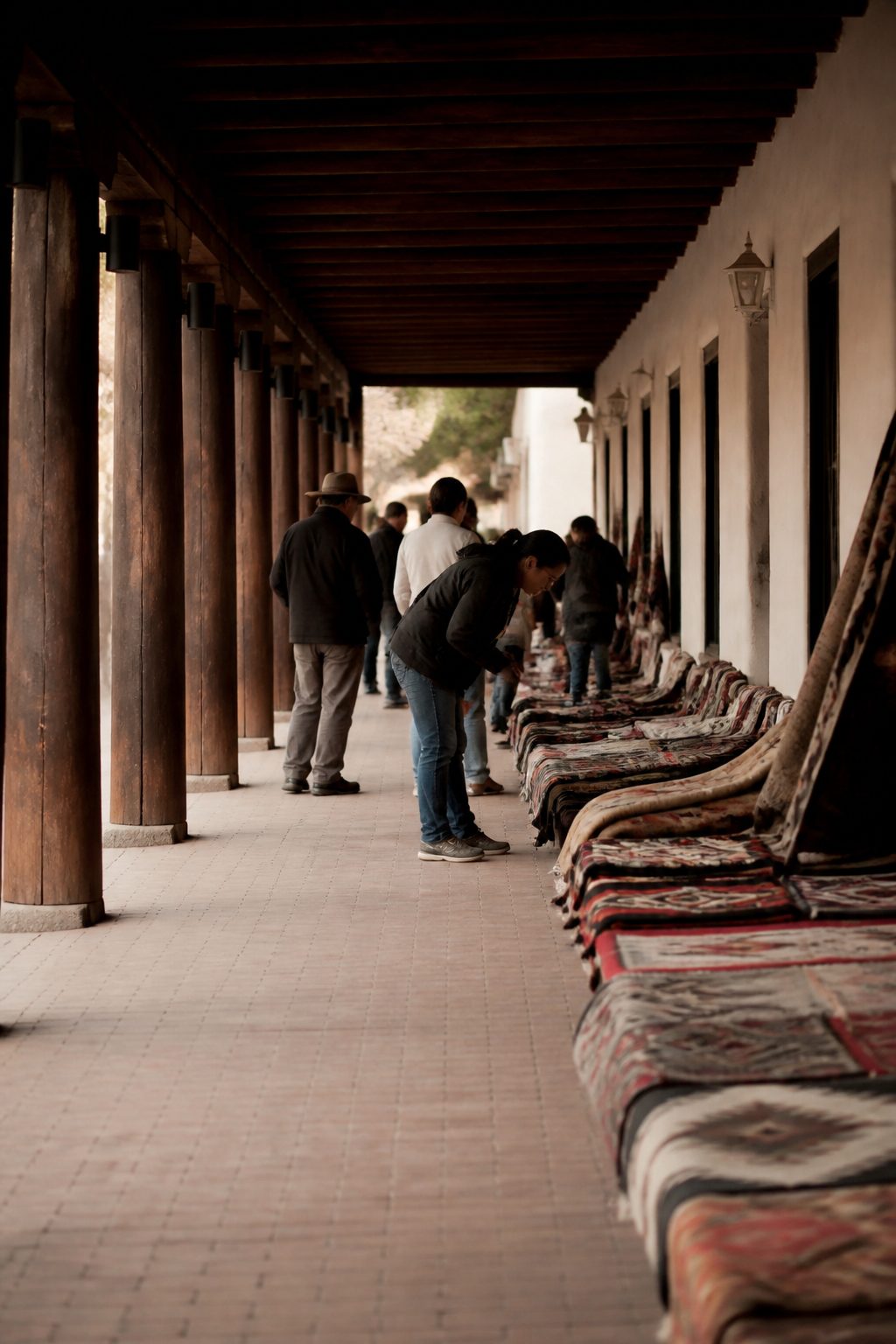
The Plaza is four sides of low buildings around a square of grass, benches and old trees, with a bandstand and a great deal of shade. On the north side, under the long portal of the Palace of the Governors, the Native American Vendors Program has operated since the 1930s: artists are juried by the museum, spaces are assigned by daily lottery, and you buy directly from the person who made the piece. It is the most reliable place in the city to buy Native work with no ambiguity about provenance.
The center of the Plaza is currently a subject rather than a monument. An obelisk raised in 1868 stood there for a century and a half, carrying inscriptions that had been contested for decades; it was pulled down in October 2020, and what should replace it has been running through a formal public process ever since. Expect the middle of the square to look unresolved. It is.
Around the square, the New Mexico Museum of Art occupies the northwest corner in the 1917 building that more or less defined Spanish-Pueblo Revival for the next century. East of the Plaza, San Francisco Street runs to the Cathedral Basilica of St Francis of Assisi, which is deliberately, conspicuously not in the local style: it is a French Romanesque building raised from 1869 by an archbishop from the Auvergne, and its foreignness is the point.
08 Words used in this chapter
- Viga
- A round timber roof beam, traditionally a peeled log, often projecting through the exterior wall. The projecting ends are structural in old buildings and decorative in most new ones.
- Portal
- A covered walkway along the front of a building, carried on posts and corbels. Pronounced with the stress on the second syllable. The Palace of the Governors has the most famous one in the state.
- Placita
- A small enclosed courtyard, the organizing unit of old Santa Fe domestic building. Many downtown shops and restaurants are placitas with a roof or a gate added.
- Latilla
- The small peeled sticks laid across vigas to form a ceiling, usually herringboned. Look up in any old room.
- Hispano
- In New Mexico, the descendants of the Spanish-speaking colonial population, distinct in history and self-description from later Mexican immigration. The term matters locally.
- Pueblo
- Both a village and a nation. Capitalized when it refers to the people or a specific community; lower case when it refers to the built form.