01 What is the Contemporary Hispanic Market?
Every July, two Hispanic art markets open within a few minutes' walk of each other, and it is easy to drift from one into the other without noticing that you have changed markets. Traditional Spanish Market fills the Plaza, one of Santa Fe's three great markets. The Contemporary Hispanic Market runs up Lincoln Avenue, the short street that leaves the northwest corner of the Plaza between the New Mexico Museum of Art and the Palace of the Governors.
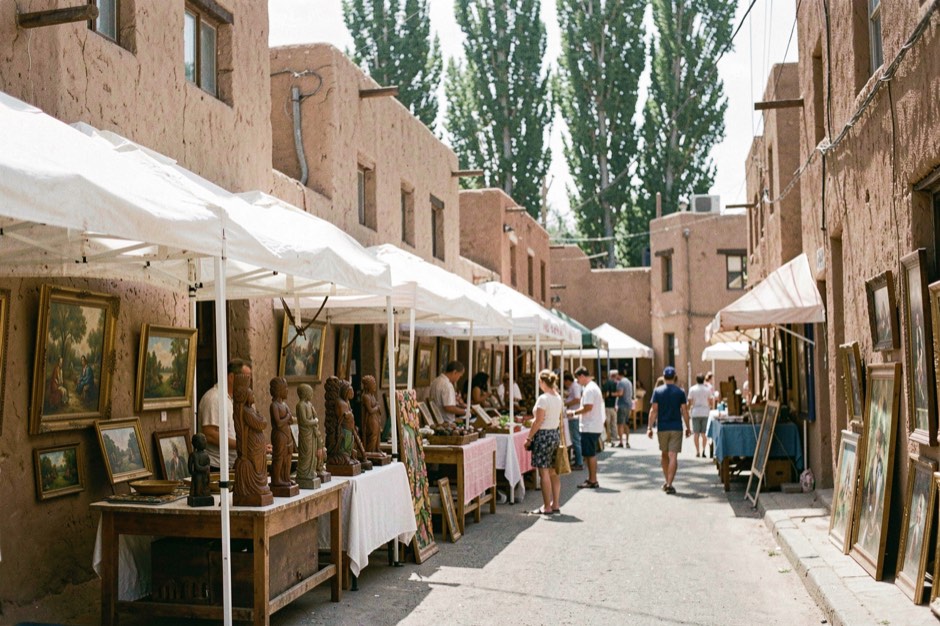
It is a juried show. Artists apply, are selected by a jury and pay for a booth, and the organizers' motto is three words long: making new traditions. To exhibit, an artist must be at least part Hispanic and a full-time resident of New Mexico, according to the Santa Fe visitors bureau's account of the rules. What the jury does not do is hold the work to a historic form. Painting, photography, printmaking, jewelry, ceramics, furniture, weaving, and sculpture in wood, stone or bronze all have a place on the street.
In 2026 the market filled 128 booths, according to the Albuquerque Journal, and entry was free on both days, from 8 a.m. to 5 p.m. The organizers say collectors travel from across the United States to add to their private collections, and the street is just as open to anyone who wanders up from the Plaza with no plan to buy.
02 How is it different from Traditional Spanish Market?
The two markets share a weekend, a culture and a good part of their audience, and they differ on almost everything else. The quickest way to see it is side by side.
| Traditional Spanish Market | Contemporary Hispanic Market | |
|---|---|---|
| Where | The Plaza | Lincoln Avenue, north of the Plaza |
| Run by | Spanish Colonial Arts Society, founded 1925 | Contemporary Hispanic Market Inc., run by volunteers |
| First held | 1926, restarted in 1965 | Mid-1980s; the 2026 edition was billed as the fortieth |
| What the jury asks | Work inside a named traditional category, judged on historic forms and materials | Quality of the work, across eighteen categories including contemporary media |
| Typical work | Retablos, bultos, straw appliqué, tinwork, colcha, Rio Grande weaving | Painting, photography, jewelry, ceramics, sculpture, furniture, printmaking |
| Size | Around two hundred juried artists | 128 booths in 2026 |
| Entry | Free to walk | Free |
The difference that matters to a buyer is the question the jury asks. On the Plaza, a retablo is judged against what a New Mexican retablo historically was, down to the pine, the gesso and the pigments; the Spanish Market chapter sets out the traditional categories and what each one constrains. On Lincoln Avenue the jury looks at the work in front of it rather than at a historic model. Ramona Vigil-Eastwood, the market's president, told the Albuquerque Journal that it is "a little bit more easygoing" than the traditional market.
Neither market is a lesser version of the other. One keeps a set of historic forms alive by paying for them; the other gives the same community a place to show what it makes now. Seeing both on the same morning puts the old forms and the new work side by side, a short walk apart.
03 Where did the market come from?
The Contemporary Hispanic Market began as an alternative for artists whose work did not fit the traditional market's definition of traditional, and who therefore had nowhere to show on Spanish Market weekend. The categories on the Plaza were not going to change: protecting historic forms was the point of them. So the artists who worked outside them started their own show.
It began small. About eleven artists set up in the back of a courtyard near the Palace of the Governors, at the north edge of the Plaza. One of them, Francisco Sanabria, born in Bucaramanga, Colombia, and living in Santa Fe since the 1980s, was interviewed by the Albuquerque Journal when the market marked forty years in 2026.
As it grew, the market moved out of the courtyard and onto Lincoln Avenue, where it has stayed. Accounts differ by a year or so on the start date: the 2026 edition was presented as the fortieth, which puts the first market in 1986 or 1987 depending on how the years are counted. The first quarter century is documented in a book, Contemporary Hispanic Market: 25 Years, by Paul Rhetts and Barbe Awalt, a finalist at the 2011 New Mexico Book Awards, whose publishers describe the market as run by artists for artists.
The organization behind it has stayed small. It is run by volunteers who meet monthly throughout the year, and Ramona Vigil-Eastwood has been its president since 2006. Her own summary of the rule that defines the market is that the art is made in New Mexico, by Hispanic artists.
04 What will you find on Lincoln Avenue?
The categories are the clearest sign of how wide the market's definition is. The Albuquerque Journal counted eighteen in 2026. Alongside painting, sculpture, photography, printmaking, jewelry, ceramics, furniture and fiber arts, the account of its first twenty-five years lists glass, tiles, mixed media, drawing and pastels, recycled art, computer art, Day of the Dead pieces and skateboards. Devotional art and tinwork appear too, without the material rules that apply on the Plaza.
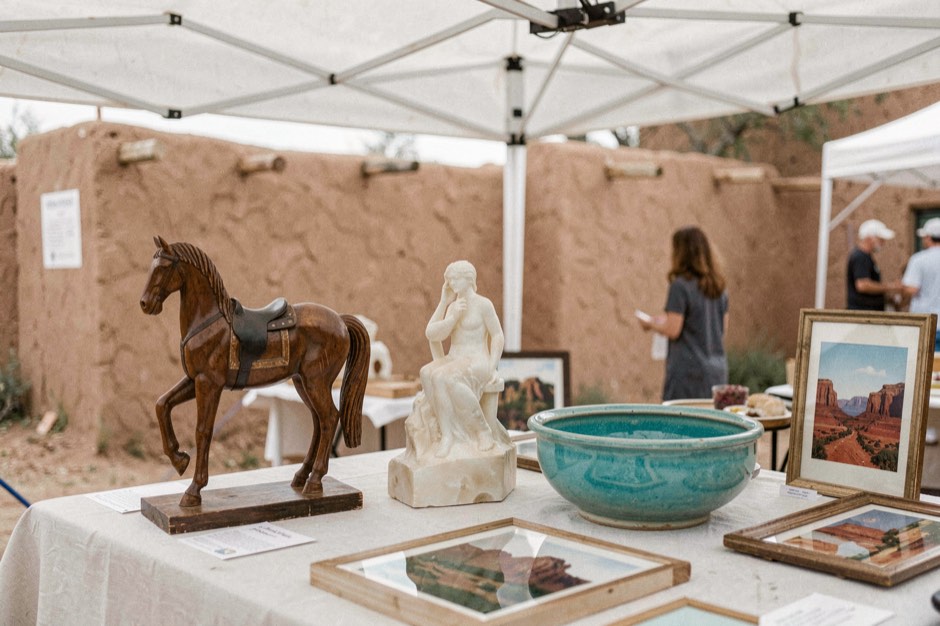
The roster also changes more than a returning visitor might expect. Of the artists showing in 2026, about forty were taking part for the first time, roughly a third of the total, and the organizers describe the jurying as more competitive each year as the number of applications rises.
Two smaller things are worth finding. Works donated by current artists go into a silent auction at the information booth, and each year's market poster, the work of a winning artist, is sold by the organizers. Both are easy to miss if you walk the street only for the booths.
05 Who can show there, and how are artists chosen?
Eligibility has two conditions: Hispanic heritage, at least in part, and full-time residence in New Mexico. The second is what keeps the market regional. It is not a national survey of Latino art; it is a show of what Hispanic artists living in New Mexico are making now.
Selection happens months before July. The published calendar for the 2026 market ran in four steps:
- 10 January. Entry day: the work, the application and the fees, delivered between 8 and 11 in the morning.
- 20 February. Notification of results mailed.
- 20 March. Postmark deadline for booth fees and contracts.
- The last full weekend of July. The market itself, 25 and 26 July in 2026.
Entry day involves bringing the work itself, which is collected again the same afternoon, so the jury sees the objects rather than pictures of them. For a visitor, the practical consequence is that every booth on the street has passed a jury, which is the whole difference between a juried market and a craft fair, and that the line-up is never quite the same two years running.
06 How do you see both markets in one day?
Start early and it is comfortable. The Contemporary Hispanic Market opens at 8 in the morning, and the two markets are a few minutes apart on foot: walk the Plaza while the crowd is still thin, then cross Palace Avenue at the Museum of Art corner and work north up Lincoln Avenue. The Plaza market keeps its own hours, so check them with the Spanish Colonial Arts Society.
Plan for the afternoon sky. Late July falls in the monsoon, and the organizers tell visitors to bring rain ponchos, adding that a downpour of at least twenty minutes arrives every year. They call it a blessing on the market; it is also a good reason to do the serious looking before lunch. The weather chapter explains how the summer monsoon shapes a July afternoon.
Decide on Saturday if you can. The visitors bureau notes that some artists sell out on the first day, and there is no second chance once a piece has gone. Prices are set by each artist. If the artist is in the booth, ask how a piece was made: with no historic category to explain it, that conversation is the quickest way into the work.
Book the weekend early. The streets around the Plaza are at capacity, and lodging for Spanish Market weekend is best reserved six to nine months ahead. Water, sunscreen and a hat matter more than they seem to at 7,199 feet, even on a morning that starts cool.
07 The market at a glance
- Name
- Contemporary Hispanic Market
- What it is
- A juried market of contemporary art by Hispanic artists living in New Mexico
- Where
- Lincoln Avenue, north of the Santa Fe Plaza
- When
- The last full weekend of July, 8 a.m. to 5 p.m.; 25 and 26 July in 2026
- Since
- The mid-1980s; the 2026 edition was billed as the fortieth
- Size
- 128 booths and eighteen categories in 2026
- Who can show
- Artists at least part Hispanic, living full time in New Mexico, selected by a jury
- Organizer
- Contemporary Hispanic Market Inc., run by volunteers; president Ramona Vigil-Eastwood since 2006
- Entry
- Free
- Same weekend
- Traditional Spanish Market on the Plaza, run by the Spanish Colonial Arts Society
08 Three short answers
Is the Contemporary Hispanic Market free?
Yes. Admission is free on both days, and the booths line Lincoln Avenue, north of the Santa Fe Plaza, from 8 a.m. to 5 p.m.
When is the Contemporary Hispanic Market in 2027?
It is held on the last full weekend of July, the same weekend as Traditional Spanish Market. In 2027 that weekend falls on 24 and 25 July; confirm with the organizers once they publish the year's dates.
Is there a winter Contemporary Hispanic Market?
The organizers' own site lists only the July market. The Hispanic art market on the December calendar is the Winter Spanish Market of the Spanish Colonial Arts Society, a smaller indoor show held in early December.