01 What paperwork should a newcomer check before looking at the paint?
Do the paperwork first, because a perfect car with a faulty file is worthless to you. The registration certificate, the carte grise, must be in the seller's name, and the seller signs the transfer of ownership. Ask for a recent certificate of administrative status, which shows whether the car has an outstanding lien or a legal block on it. In France it can be requested free online, and it takes the guesswork out of a private sale.
For a car more than four years old, the seller normally has to provide a roadworthiness inspection report, the contrôle technique, issued within the last six months. Read it line by line. Minor defects are listed there, and so are any that must be repaired and re-checked. A report older than six months is a reason to pause.
After the sale, the new owner has about a month to register the car in their own name. This is done online through the national agency ANTS, which publishes the procedure at ants.gouv.fr. A newcomer needs proof of address, identity and, in most cases, a valid insurance certificate for the car, so arrange insurance before you drive away.
02 How do you read a car's bodywork in daylight?
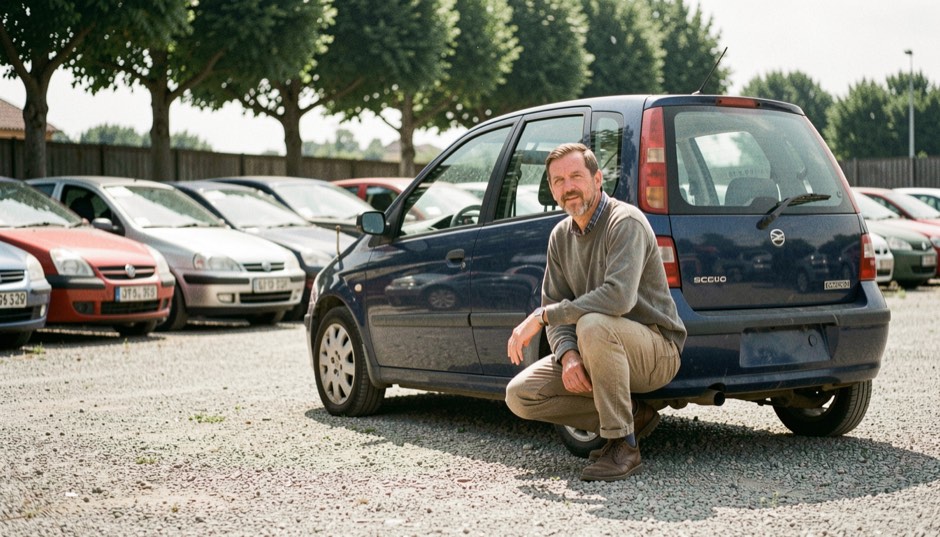
Ask to see the car outdoors, in dry weather, in the morning or late afternoon when the light is low. Rain and strong midday sun both hide small faults. Walk around the car slowly and look along each side from the front and the rear corner, with your eye near the level of the panel. Ripples and dents show as bent reflections.
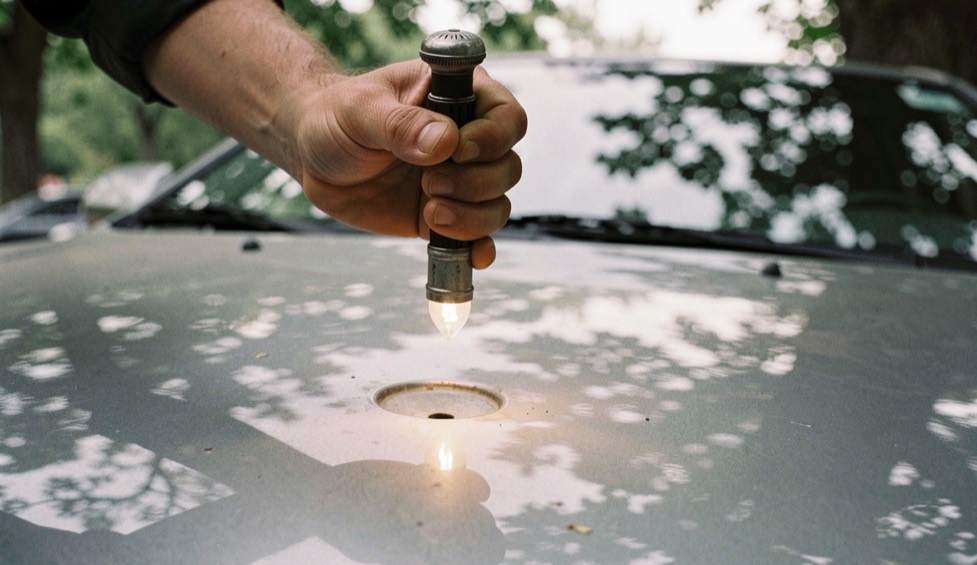
A phone light or a small torch, held low and almost flat against the paint, throws a shadow into every dent. That is the quickest way to count the small marks on a door or bonnet. Small dents are the most common thing you will find on a used car, and many of them can be pushed out by hand without repainting when the paint is still intact. A paintless dent repair workshop around Gémenos, to the east of Marseille, asks for photographs and calls back with a free quote, which is a convenient way to put a price on a dent before you negotiate.
Then check what the surface says about earlier repairs. Look for panels whose colour differs slightly from their neighbours, for fine paint dust on rubber seals or trim, and for gaps between panels that change width from one end to the other. A small magnet drawn over a steel panel will stick firmly to bare metal and weakly or not at all over thick filler, though it does nothing on aluminium or plastic parts.
03 Which dents can be repaired without repainting, and which cannot?
Paintless repair works by reshaping the metal from behind, so it depends on the paint staying whole. A shallow dent on a flat part of a door or wing, with clear unbroken paint, is the easiest case. A dent on a body line, an edge or a pleat of the panel is harder because the metal is stretched, and a cracked or flaking finish sends the job back to conventional bodywork with paint.
A workshop that does this work will tell you which case applies if you send photographs, and an honest one says when a traditional repair is the better route. That is useful at the negotiating stage. A dent that can be pushed out by hand is a modest deduction. A dent on an edge, with chipped paint, is a larger one.
Bumpers need separate thought. Plastic cracks rather than dents, and a cracked bumper often needs a replacement or a repaint. Ask the seller whether any bumper has been resprayed, and look for a texture or a gloss that differs from the rest of the car.
04 What does hail damage look like, and should you avoid it?
Hail leaves many small round dents across the roof, the bonnet and the boot lid, the surfaces that face the sky. Seen in raking light they look like a field of shallow dimples. The south of France has a thunderstorm season, and cars that were parked outdoors during a storm turn up on the used market at lower prices.
A hail-damaged car is not necessarily a bad purchase. If the paint is intact, a trained technician can often work out the dents by hand, though a roof with dozens of impacts is a long job and a cost you should price before agreeing the sale. If the paint is cracked in many places, the car will need repainting and the saving may disappear.
Ask the seller directly whether the car has been hit by hail, and whether an insurance claim was made. A car that was declared seriously damaged by an insurer's expert carries a mention on its registration record, so ask to see the file and read it. A seller who answers openly is a good sign, and one who changes the subject is worth walking away from.
05 What should you ask the seller about earlier repairs?
Ask about the history in simple questions. When was the last service, and is there a service book? Was the car ever in an accident? Has any panel been repainted, and if so, why? A genuine seller can usually answer these in a minute, and a vague answer tells you something too.
Ask for invoices. Repair invoices for bodywork show what was done, by which workshop and when, and they match the marks you can see. A fresh respray with no invoice deserves a closer look, especially around door edges and the bonnet, where paint runs thin. Compare the mileage in the service book with the dashboard, and check that the chassis number on the registration certificate matches the one stamped on the car.
If anything feels uncertain, ask whether you can have an independent garage check the car before you pay. Sellers who agree to this are rarely hiding a major problem.
06 How long should an inspection and test drive take?
Give yourself at least an hour. Spend the first twenty minutes on the paperwork and the walk-around, and keep the test drive for after you are satisfied with the file. On the road, listen for clicks and rattles over bumps, check that the car tracks straight on a flat road, and make sure every switch and window works.
A newcomer has one advantage: no hurry. Cars are sold every day, and a calm buyer who walks away from a weak file or a poor repair is the one who ends up with a good car. Take photographs of the marks you saw, send them to a repairer for a quote, and use the figure as part of the price discussion.
When you agree, write down the price and the date on the transfer document, keep a copy of everything, and register the car within the month. Keep the repair quote with the file. If you later sell the car, a clean history of small repairs done properly helps the next buyer as much as it helped you.